

Welcome, lovers of the sea and adventure! At Wild Nature Surf Camp, in Sines/Porto Covo, in the heart of the Costa Vicentina, we believe that every wave is an opportunity and every surfer has a unique path to follow. And at the heart of that journey lies a crucial decision: choosing the right surfboard. It’s not just a piece of foam and fiberglass; it’s your extension in the water, the tool that will propel your progress and ensure that every session is unforgettable. Get ready to dive in with us in this comprehensive guide and discover how to find your aquatic soulmate. Surf with soul, live with passion, be wild!
The Importance of the Right Surfboard: The Secret to Your Progress
Choosing the right surfboard is undoubtedly one of the cornerstones of consistent and enjoyable progress in surfing. A board that doesn’t match your skill level, weight, or ocean conditions can turn a dream session into a frustrating challenge. On the other hand, the ideal board provides the stability, buoyancy, and maneuverability you need to feel confident, catch more waves, and, above all, have the most fun possible [1].
Essential Dimensions: What You Need to Know
Before we explore the different types of surfboards, it is essential to understand the dimensions that define them and how these influence their performance in the water [2]:
- Length: A longer board offers greater stability and makes paddling easier, making it ideal for beginners. Shorter boards are more maneuverable but require greater control and technique.
- Width: Wider boards provide more stability and buoyancy, making it easier to catch waves. Narrower boards are faster and allow for tighter turns.
- Thickness: A thicker board has greater buoyancy, which makes paddling and catching waves easier. However, it can make more extreme maneuvers more difficult.
- Volume (Capacity): Measured in liters, volume is the sum of the three dimensions. Greater volume means more buoyancy and stability, which is crucial for beginners and for catching waves with ease. As we progress, we can opt for boards with less volume for greater maneuverability.
Types of Surfboards and Your Progress in Surfing
The world of surfboards is vast and diverse, with models designed for every stage of your journey. Let’s take a look at the main ones:
Softboards: Your Best Friend When You’re Just Starting Out
For those taking their first steps in surfing, softboards (or foam boards) are the perfect choice. These boards have a lot of volume and are covered with a soft layer of foam, which makes them extremely safe, stable, and easy to paddle [3]. Their superior buoyancy makes it easier to catch waves, reducing frustration and speeding up the learning process. At Wild Nature Surf Camp, softboards are our go-to tools for ensuring you feel comfortable and confident right from your first lesson. They’re durable, affordable, and—contrary to popular belief—can also be fun for more experienced surfers on days with small waves [4].
Longboard: Elegance and Stability
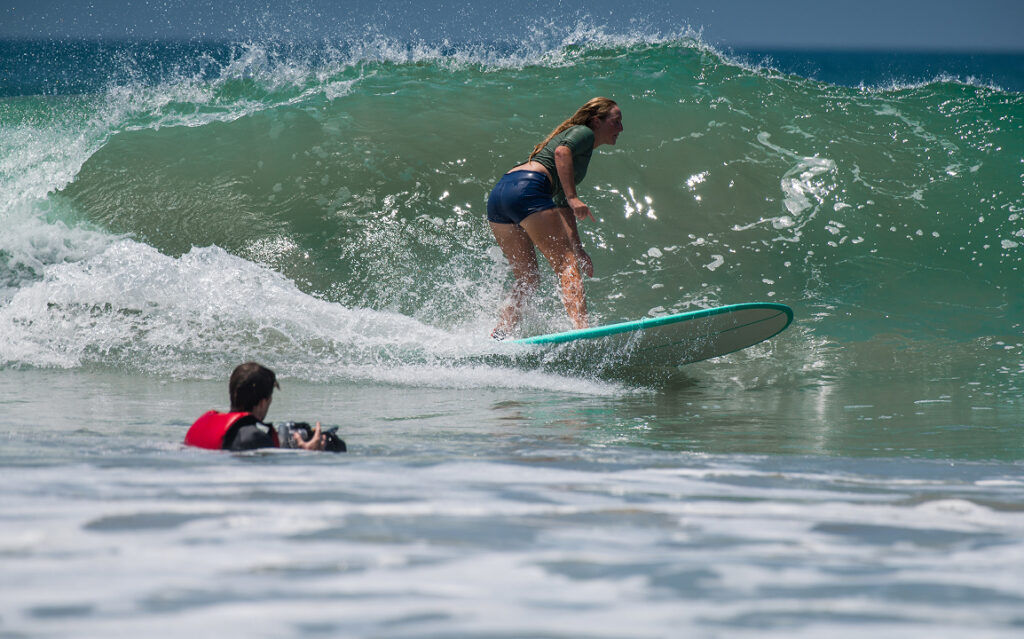
Longboards are the classic surfboards, ranging in length from 9 to 12 feet. They offer exceptional stability and buoyancy, making them ideal for beginners looking for a solid foundation, but also for surfers who appreciate a smoother, more elegant style [1]. They allow for maneuvers like the “Hang Five” and “Hang Ten,” and are perfect for longer, fuller waves. If you’re looking for a more traditional and fluid surfing experience, the longboard might be your ideal companion.
Funboard/Malibu: The Bridge to Evolution
Funboards, also known as Malibus, are the bridge between longboards and shorter boards. Ranging in size from 6 to 8 feet, they combine the stability and volume of larger boards with enhanced maneuverability, allowing you to start trying out your first maneuvers [1]. They’re an excellent choice for beginner surfers with some experience or for intermediate surfers looking to transition to smaller boards. Their versatility makes them fun in a variety of wave conditions.
Fish: Fun in Small Waves
Fish boards are characterized by their width and their “swallowtail” shape. Generally shorter (less than 7 feet), they are ideal for small and medium waves, offering good speed and stability due to their extra volume [1]. They’re a great option for intermediate to advanced surfers who want to maximize their fun on days with less powerful waves, allowing for quick and fluid maneuvers.
Shortboard: For Those Seeking Performance
Shortboards are high-performance boards used by professional surfers. Small, agile, and with less volume, they require an advanced level of surfing skill and good physical conditioning [1]. They are designed for radical, fast maneuvers and are ideal for strong, fast waves. If your goal is performance and executing complex maneuvers, a shortboard will be your ultimate choice, but remember that your progression toward it should be gradual.
Gun: Taming the Giant Waves
Gun boards are designed specifically for big, powerful waves. They are long, narrow, and have pointed noses, designed to provide speed and stability in extreme conditions. These are not boards for beginners, but rather for very experienced surfers looking to push the limits on giant waves [1].
Factors to Consider When Making Your Choice
To make the best decision, consider the following points:
Your Level of Experience
Be honest with yourself. Are you just starting out? Are you an intermediate surfer who’s already hitting some walls? Or are you an advanced surfer looking for performance? Your skill level is the most important factor in determining the volume and type of board [3].
The Type of Waves
Where do you usually surf? In Sines/Porto Covo, we have a variety of waves, but it’s important to consider whether you’re looking for boards for small, mushy waves or for larger, more powerful swells. Boards with more volume and width are better for small waves, while narrower boards with less volume are better suited for larger, faster waves [3].
Weight and Volume
Your body weight is crucial for determining the ideal board volume. The heavier you are, the more volume you need for buoyancy and stability. There are reference charts that can help you calculate the ideal volume based on your weight and skill level [3].
Materials and Construction
Softboards are ideal for beginners because they are safe and durable. Epoxy boards are lighter and more durable, while polyester boards offer greater responsiveness and performance, making them the preferred choice for advanced surfers [3].
Fin Configuration
Fins affect the board’s control and speed. The most common configurations are single fin (classic), twin fin (for fun in small waves), thruster (three fins, the most versatile), and quad (four fins, for greater grip and speed) [3].
Conclusion: Your Board, Your Adventure
Choosing the right surfboard is an exciting part of your surfing journey. There’s no one-size-fits-all answer—it’s about finding the board that best suits you, your skill level, and your goals. At Wild Nature Surf Camp, we’re here to guide you every step of the way, from choosing the perfect board to catching your first wave. Remember: the best board is the one that makes you smile and leaves you wanting more. Surf with soul, live with passion, be wild!
Come Surf With Us at Wild Nature Surf Camp! Ready to put this knowledge into practice and have the surfing experience of a lifetime? At Wild Nature Surf Camp in Sines/Porto Covo, we offer lessons for all skill levels, with experienced instructors and the right equipment to help you improve. Book your vacation or surf lessons now and let us share with you the magic of the waves along the Costa Vicentina. Your adventure awaits!
Frequently Asked Questions (FAQ)
1. What is the best surfboard for a beginner?
For beginners, softboards are the most recommended. They offer great stability, buoyancy, and safety, making it easier to paddle and catch your first waves, which speeds up the learning process and builds confidence in the water.
2. Can I use a shortboard as a beginner?
It’s not advisable. Shortboards require an advanced level of technical and physical skill due to their lower volume and stability. Starting out on a shortboard can lead to frustration and hinder your progress as a surfer.
3. What is board volume, and why is it important?
Volume, or displacement, indicates a board’s buoyancy. It’s crucial because a volume that’s appropriate for your weight and skill level makes paddling, stability, and catching waves easier, making the experience more enjoyable and effective.
4. When should I switch from a softboard to a more advanced surfboard?
You should consider making the switch once you feel comfortable catching waves, paddling efficiently, and making your first basic turns. Generally, a funboard or Malibu is the logical next step to continue your progress.
5. Do sea conditions influence the choice of surfboard?
Yes, very much so. Small, weak waves are best suited for boards with more volume and width (such as fish boards), while larger, more powerful waves are better suited for boards with less volume and a narrower profile (such as shortboards or guns).
6. What are keels, and what is their function?
Fins are the “fins” on the bottom of the board that provide direction, control, and stability. Their configuration (single, twin, thruster, quad) directly affects the board’s maneuverability and speed in the water.
References
[1] EasyDrop. (2020). What are the different types of surfboards? Check out 6 models! Available at: https://easydrop.com/pt/blog/tipos-de-prancha-de-surf/
[2] Dude Surf School. (2026). How do I choose my next surfboard? Available at: https://dudesurfschool.com/escolher-prancha-de-surf/
[3] Mundo-Surf. (n.d.). Criteria for Choosing a Surfboard. Available at: https://www.mundo-surf.com/pt/blog/surfe/criterios-para-tomar-escolher-uma-prancha-de-surf
[4] Core Surfing Shop. (n.d.). Softboard: Why Is It the Best Surfboard for Beginners? Available at: https://blog.coresurfingshop.com/softboards-aprende-mas-rapido-a-hacer-surf/
 TAGS:
TAGS: